Capsule Hotels: a bed that is its own enclosed unit.
Capsule Hotels · 3 hotels
This section is short on purpose. A hotel belongs here only when the sleeping place is a separate closed cell with its own door or blind, not a room and not a bunk in a shared dormitory. Two of the three sit inside airports, which is where the format now does most of its work. Hostels, micro-rooms and pod-styled bedrooms with a full door are all excluded.
07
Tokyo, Japan
Nadeshiko Hotel Shibuya
A women-only capsule hotel in Shibuya built around a hinoki wood bath
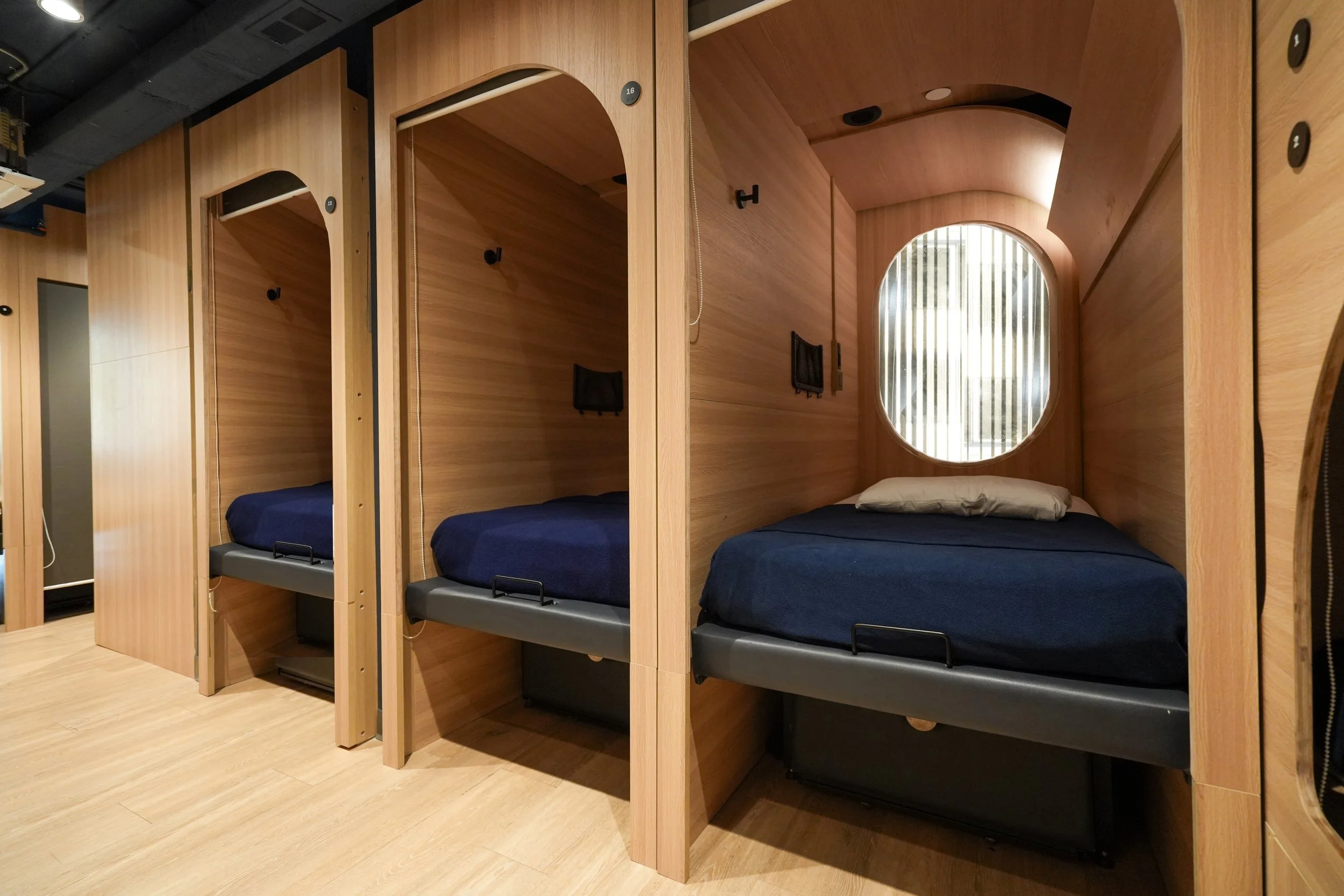
Nadeshiko Hotel Shibuya: the wooden capsule frames.
ARRIVING
Shibuya is dense, and the entrance is narrow, marked by a sign rather than by a frontage. A lift carries guests up from street level. Shoes come off at the threshold, and the floor changes to wood. Reception is a counter, not a lobby, and everything beyond it is for women only.
THE EVENING
Most of the building's character sits in the bath, where hinoki cypress is used for the tub and the smell of it reaches the corridor. There is a lounge with low tables, and guests read there, work, or simply stop for a while. Voices stay low without anyone asking for that. Shibuya continues underneath the windows at full volume.
THE NIGHT
Sleeping happens in a closed capsule with a blind, a light, a socket and a shelf. The frames are wood rather than moulded plastic, which changes how a row of them looks. Bedding is arranged tightly and the corridor is kept dark. Sound is managed by agreement here, more than by any material.
THE MORNING
Bathing again is the routine, before the lockers and the shared washing area fill up. Luggage stays downstairs. Outside, the crossing, the station and the department stores are all a few minutes away on foot. Wooden floors and street noise make an odd but consistent pair in this part of the city.
Coming and goingShibuya station is a short walk with several train and subway lines, Narita and Haneda both connect by rail, and luggage space is limited, so pack small.
Read in August 2026
08
Amsterdam Airport Schiphol, Netherlands
YOTELAIR Amsterdam Schiphol
Transit cabins inside the Schiphol terminal, taken by the night or by the hour
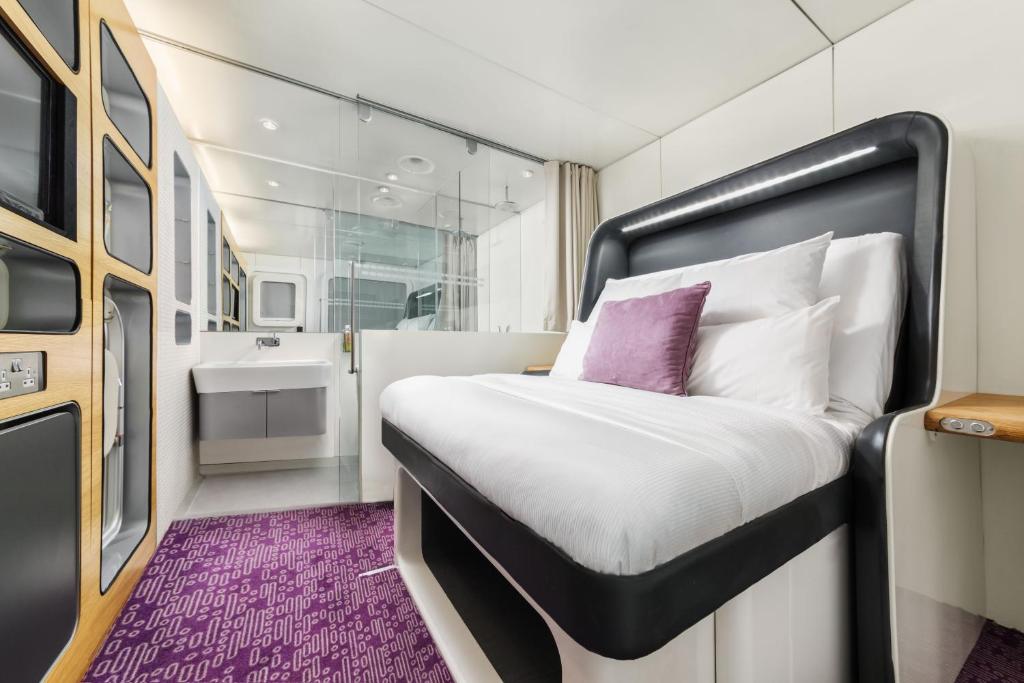
YOTELAIR Amsterdam Schiphol: a cabin inside the terminal.
ARRIVING
Schiphol has a single terminal, and the cabins sit inside it, past security in the lounge area. There is no street, no taxi rank and no front door in the usual sense. A corridor branches off the concourse, and the noise level drops immediately. Check-in is a screen and a counter, nothing more.
THE EVENING
Departure boards decide what evening means here, so the corridor is used at every hour of the day. The common area is small: seats, a machine, somewhere to charge things. Most people arrive with one bag and a connection to make. Windows, where they exist, look at aircraft rather than at a city.
THE NIGHT
Cabins are compact by design, with a bed that folds, a desk surface, and a wet room behind a door. Everything is within reach of the bed without standing up. Lighting is adjustable, the walls hold back the concourse, and aircraft are felt more than they are heard. Nothing inside the cabin suggests what is happening outside.
THE MORNING
Leaving takes minutes, because the gates are already on the other side of the wall. Showers are the main reason people stay awake for the last part of a stay. Amsterdam Centraal is a short train ride for anyone with a long gap. The terminal itself never really changed state overnight.
Coming and goingThese cabins are airside, so a boarding pass and clearing security are required, and travellers staying landside need one of the separate hotels at the airport instead.
Read in August 2026
09
Incheon International Airport, South Korea
Darakhyu
A capsule hotel inside Incheon's transfer area, meant for the gap between two flights
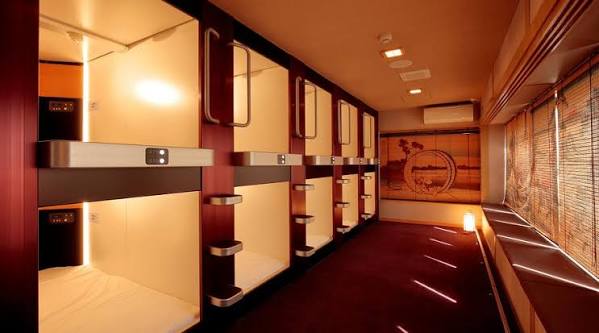
Darakhyu: capsules in the Incheon transfer zone.
ARRIVING
Incheon is large, and finding the entrance means following signs rather than a street address. The capsule hotel occupies part of the transfer zone, behind glass doors that cut out the concourse noise. Reception is compact and the corridors are lit low. Everything is measured for people carrying hand luggage only.
THE EVENING
Flight schedules matter more than the position of the sun, so the corridors stay half-busy throughout. The shared area holds seats, mirrors and charging points. Korean signage repeats in English and in Chinese. Beyond the glass, the terminal continues at its own pace, and that contrast is the whole appeal of the place.
THE NIGHT
Each capsule is a closed unit with a mattress, a screen, a light and a lockable panel, in single and double sizes. The material is smooth and pale, chosen for cleaning rather than for warmth. Shared bathrooms sit at the end of the corridor. The terminal comes through as a flat, level hum.
THE MORNING
Departure is the only reason to get up, and it is a walk of minutes. Showers and a small refreshment area handle the rest. Seoul is reachable for anyone with a long layover and the right visa status. Under daylight the terminal glass changes, but the capsules stay exactly as they were.
Coming and goingThis is inside the airport, so access depends on your ticket and on where you clear immigration; check whether your route actually keeps you in the transfer zone.
Read in August 2026
A day here is a way of describing a hotel, not a schedule: we publish no opening hours and no times. Everything comes from published material, re-read by hand, with the month of that reading at the end of each entry.
Other sections: Art Hotels · Casino Hotels · Ice Hotels